Spyce: The world’s first restaurant featuring a robotic kitchen

Michael Farid, Kale Rogers, Luke Schlueter, and Brady Knight were four MIT students and water polo teammates who were athletic and did not have time to cook their meal because of their studies and were tired of eating overpriced healthy meals. They define themselves as robotics-obsessed engineers, which gave them the idea to find a way to prepare food that is healthy but not that expensive, combining their knowledge of robotic technology. They wanted to eat healthy but that usually it’s an expensive diet, under a low student budget that was not possible. Their main idea it was to create a robot that cooked cheap, tasty and nutritious meals, served them and cleaned up after.

They spent two years before the opened Spyce working on details, trying and testing prototypes robots, working hard on perfecting their idea, in between, these guys saw the potential of business so they took some entrepreneur courses but they all were sort of engineers nerds, they did not have much culinary knowledge, they started serving food to students at an MIT dining hall and after they won $10,000 “Eat It” Lemelson-MIT prize in 2016, their idea really picked up and soon after they contacted chef Daniel Boulud which became an investor and later the culinary director at Spyce.

He was very impressed by the idea of these four MIT students, who is, by the way, a well know and awarded French chef and restaurateur who owns many restaurants in the US, most know by his restaurant Daniel, 2-star Michelin restaurant in NYC and Canada as well, including one here in Montreal called Maison Boulud located at The Ritz-Carlton, Montreal. Spyce finally opened on May 3, 2018, in Boston, Massachusetts.

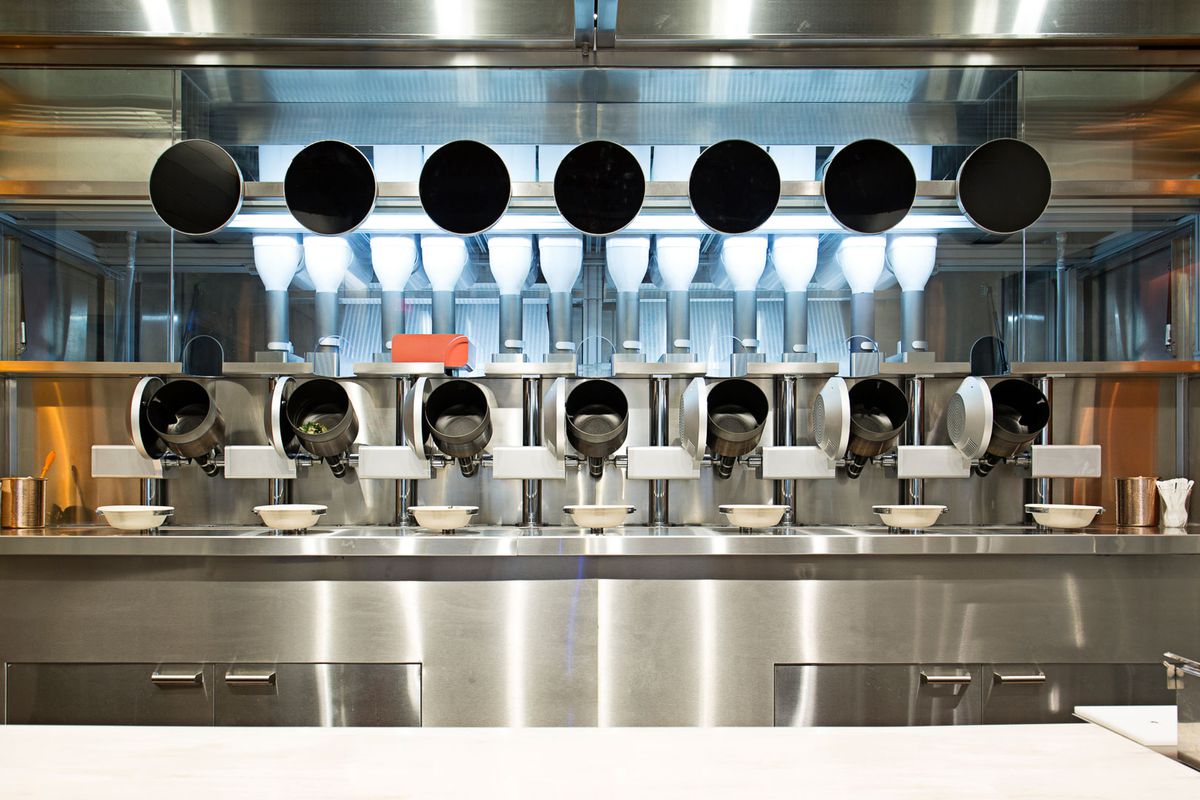
Spyce kitchen consists of seven independent robotic workstations that prepare bowl-based menus; salads, rice, curries, pasta and noodles. The Spyce robotic kitchen can prepare up to 150 meals per hour, their only inputs are electricity and water, making it 100% renewable energy. The robotic kitchen has an average of usage of 0.3 gallons of water per minute, which is 80% less than what a commercial dishwasher uses on average.

Here is how works: First you order from an electronic kiosk. A screen shows your order while the robotic kitchen works in your meal. They use induction heat and temperature control to cook perfectly on the woks (Chinese pan) who are in constant movement. They provide precision, consistency, and freshness in the preparation of each meal. They only human presence in the kitchen is the “garde manger” or “garnish employee”. They add on your toppings in the wok. This process takes no more than 3 minutes!

It is important to mention that by using robotics in the kitchen it reduces a lot the cost (labor) and the quality of the food is always optimal, using programmed robots ensures that each preparation will be the same in terms of time, temperature and preparation, which is very important to maintain a quality standard, this is why they can have a very affordable menu.

Robotic is the future of the food industry in term of labor, more and more restaurants around the world are implementing this technology, in order to reduce restaurant cost, it seems a very positive path to follow for the restaurant industry. Little by little humans are being replaced in the workforce of this industry, people are more receptive to the results of the technology applied to food and beverage services. I’m sure this will dominate the industry in the near future.

https://www.google.com/search?q=spyce+boston&rlz=1C1CHBF_enCA760CA760&source=lnms&tbm=isch&sa=X&ved=0ahUKEwjaxLLDhe7hAhVGrVkKHV30CLcQ_AUIDygC&biw=1283&bih=601&dpr=1.5#imgrc=SbocgXvYMCwfzM:
World’s High-Tech Restaurant: Ultraviolet

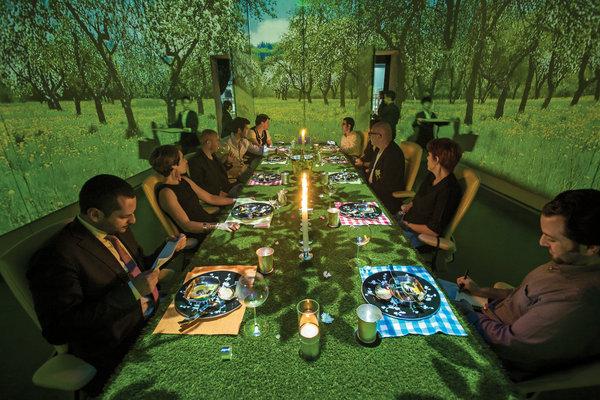
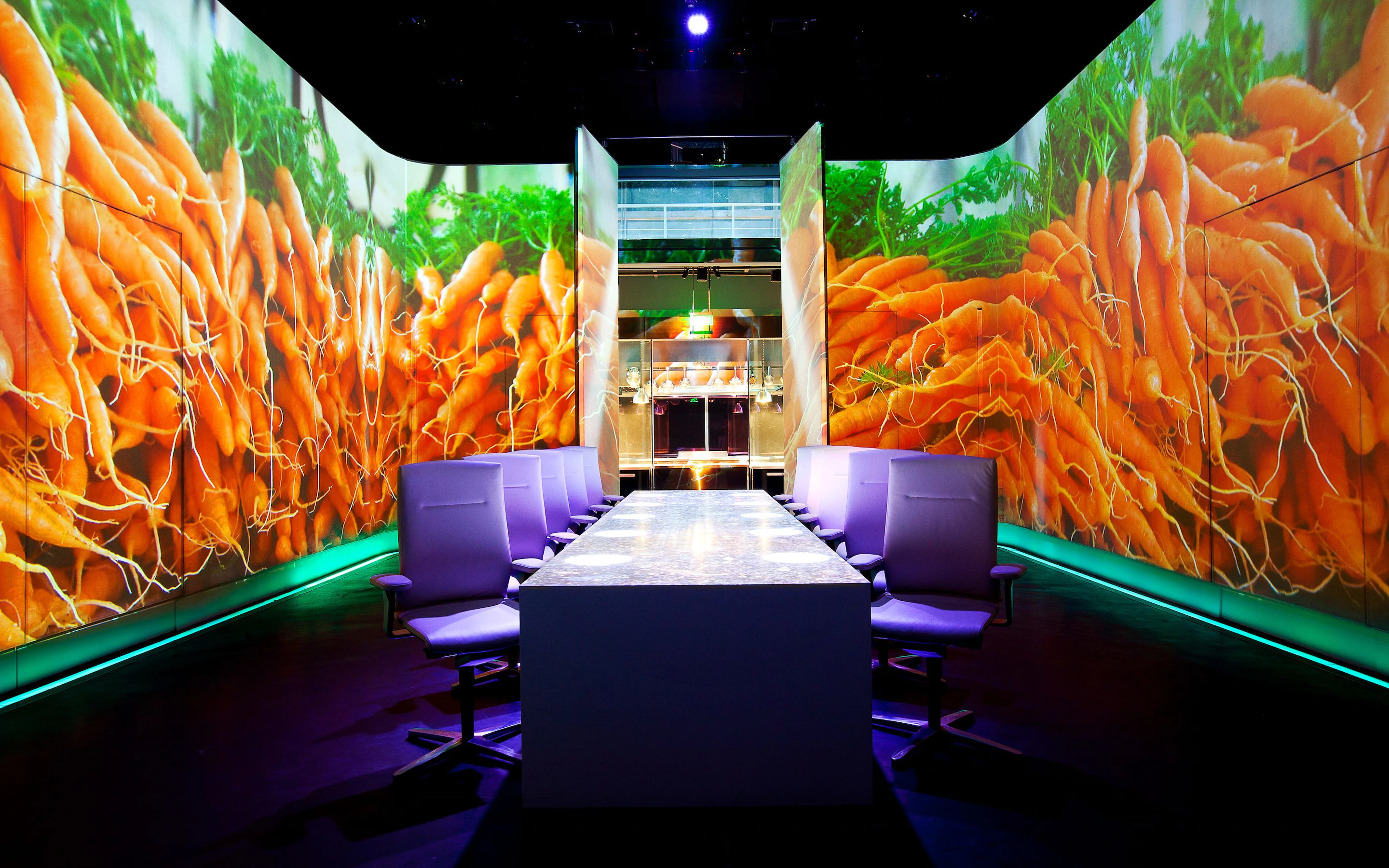
Ultraviolet is a single-table restaurant in Shanghai, China, opened in May 2012 by French chef Paul Pairet and the VOL Group.  It is the first multi-sensory restaurant in the world. Ultraviolet uses different senses such as smell, sound, touch and sight to intensify the food through a very controlled atmosphere, this include visual projector and music. The restaurant has a single table of 10 seats and serves a 20+ course dinner menu for ten guests every night.

The dining room of Ultraviolet has no decor, no artefacts, no windows, nothing. Instead the dining room is equipped with multi-sensory high-end technology, 360 degree wall projection, dry scent projectors, table projectors, UV lighting and a multichannel speaker system, creating an illusion of being in many differents places, could be the beach or a rany night, or a tropical scene, the temperature of the room drops or increases, even a breeze might start to blow inside the room. All this acording to the dish that its been served. Each of the 20+ meal courses are paired with music and visual themes and atmosphere. For example if you are eating seafood, you will see images of the ocean along with sounds of waves and a little breeze.

His vision and concept of a meal does not put food as a lonely star, although its a sophisticated cuisine, he gives a critical importance to external factors in which most of the restaurant business don’t pay much importance , such as the ambience, the sounds, the silence, the colors, emotions, memories, everything playing together as one. For him its very important to stimulate not just the taste but all senses, creating a very sensorial culinary experience.

Ultraviolet restaurant it was ranked No. 24 on the list of the world’s best restaurants in 2015. The menu costs $900 per person. They only accept online reservations and waiting list could take up to 120 days to get a spot.

Ultraviolet does not make revenue!  As they say, a “non-commercial enterprise.” That means they don’t make money. Instead of a profit forecast, they have “budgeted losses”. Since increasing the prices of their menu in 2015, Ultraviolet supposedly comes closer to paying for its operating costs, but it doesn’t, they don’t even get the money back from the initial investment.

If they don’t make much money in the restaurant how they manage to stay in business?  The answer is mainly by brand positioning, reputation building, and special events, such as private catering, their staff would travel around the world providing this service for very selective clientele.

Ultraviolet restaurant invest so much money in the customer experience and labor cost (there are 25 staff members each night of service) that even with a high price as 900 USD per person, they dont make enough to cover costs operations. On top of this, all the high tech screens surrounding the dining room and sound systems its very costly. It’s not just labor and food cost which are usually the main expenses in a restaurant, there is also high tech and engineers labor cost to be paid. What really help Ultraviolet to stay afloat are their partners in business; 34 of them (VOL Group), they are the ones with the big bucks.

Imagine when you eat a plate of food and you remember or associate that plate and its smells with your childhood, now on top of that imagine music that reminds your childhood or transport you back in time, triggering your memories, all this happening at the same as you are eating, then you see pictures proyected that might remind your childhood, that certainly will bring emotions that combined with amazing food will definitely make your day to say at least.


https://uvbypp.cc/


Molecular Gastronomy

Molecular gastronomy is linked to food science and investigates the physical and chemical transformations of ingredients that happens in the cooking process.  It is a modern style of cooking and takes advantage of many technical innovations.

In 1988 Hervé This, a french physical chemist first introduced the term “molecular and physical gastronomy” along with Nicholas Kurti, a former professor of physics at the University of Oxford, they both were interested in the science behind the culinary processes.

It has to do with transforming ingredients, but first before transforming you have to know why and how ingredients are transformed, here is when science and physics take place, related strictly to the science behind the cooking, chemical reactions and the manipulation of this science will result in amazing looking and tasty culinary results.

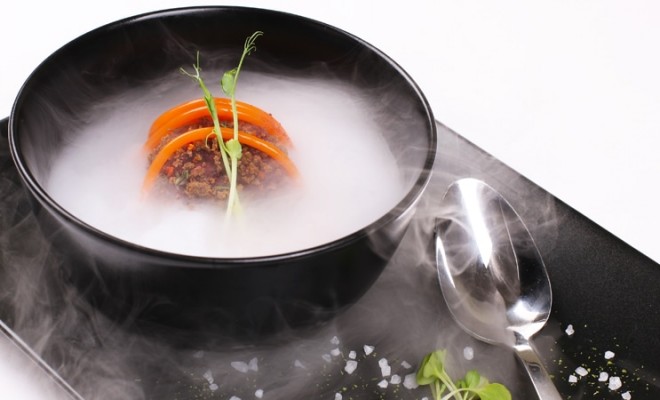
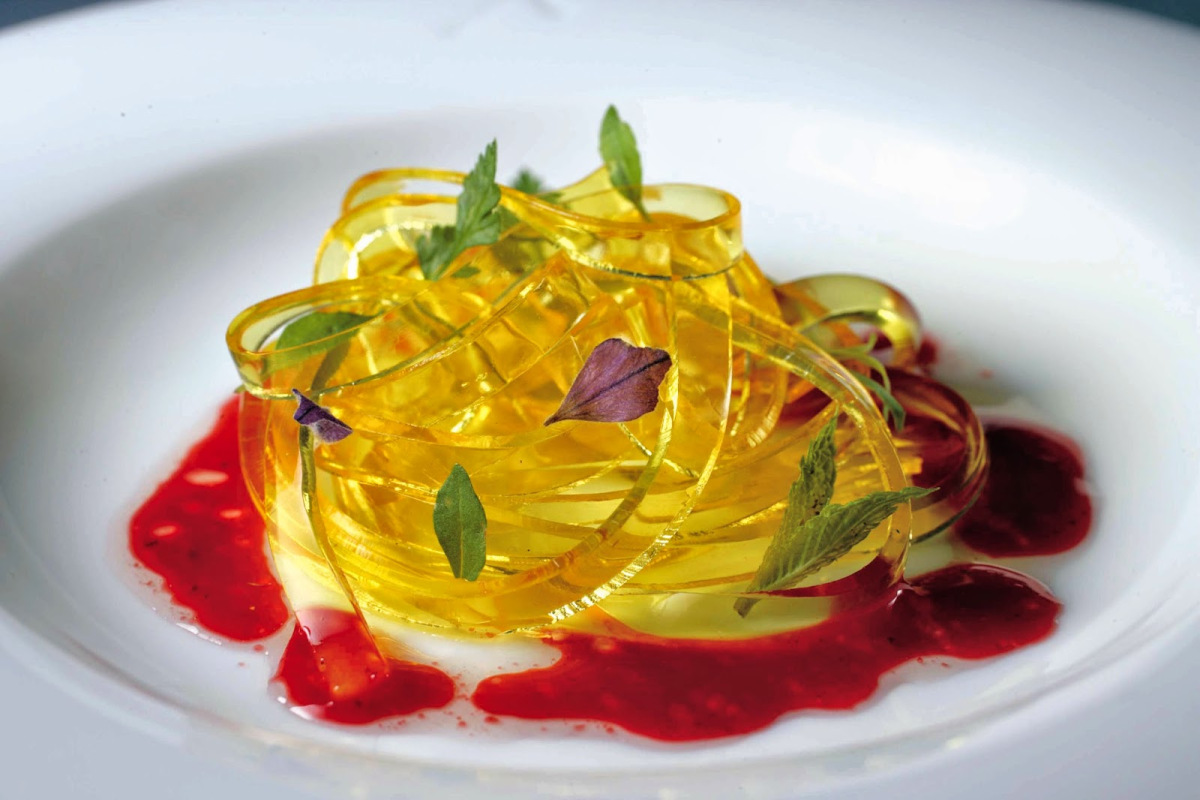
Molecular gastronomy chefs generally try to surprise you by their dishes, you would never guess what are they made of if you have one dish in front of you. They want to trick you. It’s a visual and taste experience that combined with science creates a spectacular show of colors, flavors, textures, and smells. It’s like having a mad scientist who loves cooking, a weird combination. As a matter of fact, when they first started opening molecular cuisine restaurants, they thought it was too crazy, even food critics. It took a while for people and food writers to get the whole concept. This is not about regular techniques of cooking, its about to do the impossible and completely transforming ingredients and taking them to the next level.

One of my favorite exponents of Molecular Cuisine these days is chef Grant Achatz.

His restaurant Alinea, located in Chicago, has won numerous prizes and chef Achatz has won various awards from very important and prestigious culinary institutions and publications.

In 2007, Restaurant magazine added Alinea to its list of the 50 best restaurants in the world ranked at number 36 on their exclusive list.

Alinea was awarded three stars in the 2011 and 2012 for the Michelin Guide of Chicago consecutively. Alinea was the only restaurant to receive three stars in the 2012, which is the highest rating and most prestigious rate for restaurants around the world. Watch the video below to have an idea of this genius chef and how this works at his restaurant.

These tools and new approaches in the elaboration of food have definitely changed the perception of a meal. It is hard to tell what are you eating just by seeing it. Most of the elements on the dish are transformed, it is very appealing to the eye, looks futuristic and interesting.

For me, there is no doubt that molecular cuisine will continue to explore and will find new ways to treat food ingredients, along with technology tools, and to present them to the customers, that for sure will be amazed and will expect more and more original ways to eat food.


https://www.google.com/search?rlz=1C1CHBF_enCA760CA760&biw=1283&bih=601&tbm=isch&sa=1&ei=qB_DXJnbBIWk_Qbjo7rADg&q=molecular+gastronomy+pics&oq=molecular+gastronomy+pics&gs_l=img.3…191206.196524..196844…0.0..0.201.2049.23j1j1……1….1..gws-wiz-img…..0..35i39j0j0i67j0i24.O3a-3hQVFpw#imgrc=PloHq9-VzawqyM:


Precision agriculture

A farmer really knows his field, his land, the soil, the crop (living plants grown by farmers). Each species of bug that could harm the harvest and could damage the crop during the cultivating process. Climate conditions such as the wind, rain, snow, heat and dust, they know all the effects of these in their soil, they are aware of how climate conditions could hurt the harvest creating huge issues for them. They collect data, on a basic level but often they don’t how what to do with it, that’s why they began working along with data collectors that help them to analyze their soil and potential productivity so they can increase and make more effective the process of production.

For farmers it’s crucial to maximize and increase their production mainly because of the world’s crazy growing population. By the year 2050 they estimate that farmers will need to feed 9 billion people aproximately. The result of working along with science and technology (agronomists) creates a more accurate way to produce and treat the soil.

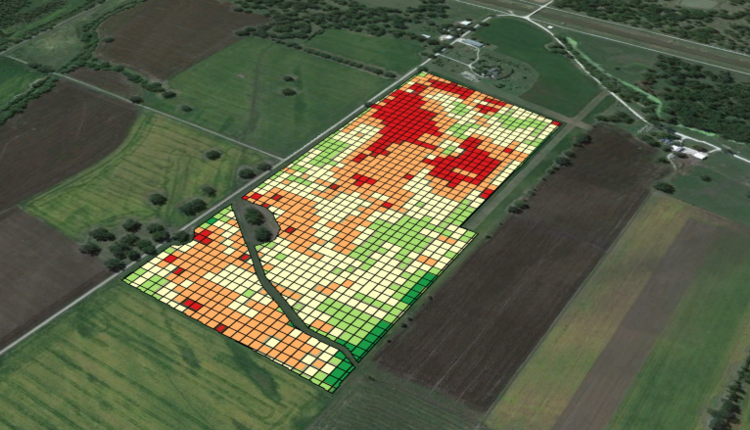
Precision agriculture is often called satellite farming, it started in the early 1990s and mainly uses GPS tracking systems and satellite images to monitor the production. They are able to scan the soil, using satellite images, identifying minerals present in the soil, so they can use the right amount of nutrients, water, pesticides to treat the soil according to their need. For example, some areas of the field might be richer in minerals than others areas of the same field, so they will focus on those sections that need more nutrients or water etc. Its a very specific way to treat the soil. A very precise way to treat the soil that in the end help them to save water, chemicals and labor cost and time.

Using these precision technology systems, farmers can identify an exact location in a field to determine how productive the area can be. Before the entire field was treated as one unit, using an equal amount of pesticides, water, herbicides, etc, but now farmers can find out which areas are more suitable for which crops so they don’t waste seed, water, fertilizer, or pesticides. For example if they analize the soil they will decide what is best to spread seeds on, based on the minerals that the soil already has, instead of planting potatoes perhaps the soil is better for planting beets or carrots.

Of course, this technology is not cheap, high tech equipment its expensive, we could assume that only big producers can access to these tools. But recently it is possible for small producers to have access to this tools by renting equipment by the hour or so. Sort of like an uber service. It’s not necessary to own these expensive devices to optimize the production of crops and try to reduce the amount of chemicals in the production process, making these technology available for most of farmers.

In other words, farmers with the help of technology, are able to minimize their production cost as well as the impact on the environment by analyzing the soil, its characteristics, and needs, the use of less or just the necessary amount of pesticides and water are essential for our health and environment care.

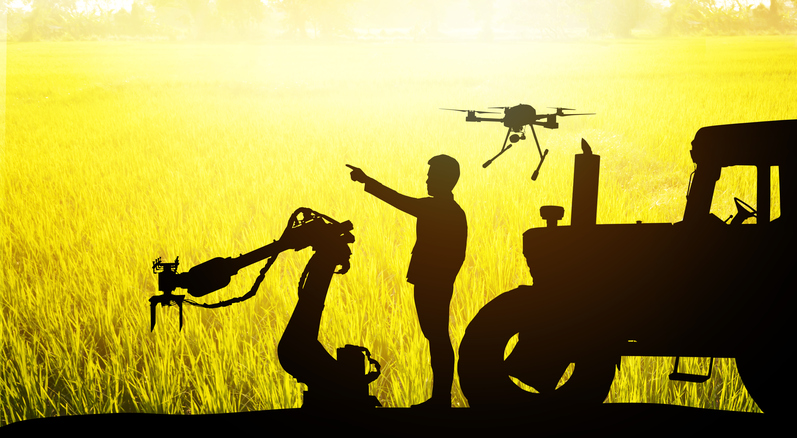
Now they have more control over their fields, they are able to use advanced tech on machinery, using self-drive tractors, drones to monitor the field and also to take high-quality images of the fields. Other innovations include a solar-powered machine that identifies weeds and precisely kills them with a dose of herbicide or lasers using drones to do the task, just to name some examples of how technology is helping farmers to improve their techniques and production.

All these tools help to keep developing the precision agriculture that is so on demand by mainly the world’s rapidly population. It is fundamental to find ways to make it effective but at the same time make a low negative impact in our environment as much as possible.


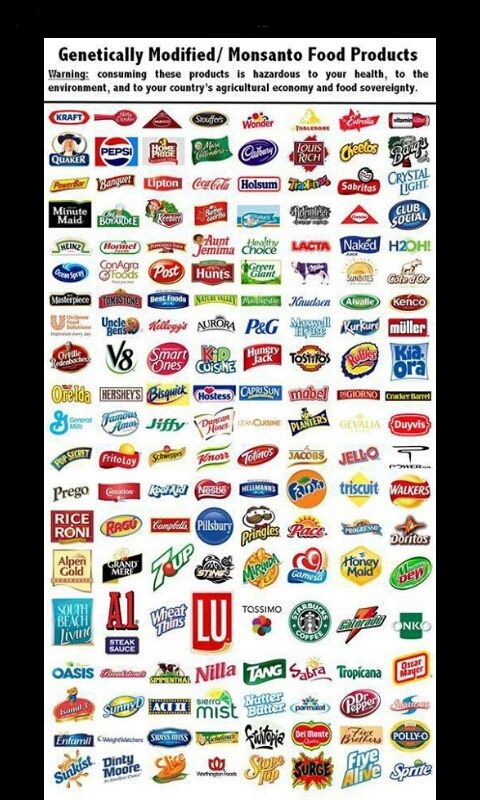
GMO & Monsanto: Impact in our life and food industry.

I was born in the early ’80s and I remember when I was growing up waiting for summertime to eat fresh cantaloupes and watermelons, I just loved them, they were summer fruits (seasonal) and after the summer was gone so they were, you would have to wait until the following summer to get them back. All this was changing rapidly, without me or many noticing but creating a whole new revolution in the producing food process and its unexpected consequences.

GMO (genetically modified organism) is basically an organism altered in a way that does not happens naturally by natural recombination or mix.
In 1994 the Flavr Savr tomato was released, it was the first genetically modified food to be sold to the public. The first ever GMO that got a license to be comerzialized for human consumption. This was the starting point that would change, affect and impact the food industry forever.

Back in the day was interesting getting fruits and vegetables available “off-season”. I don’t think anyone really paid much attention to how they did this possible, there was not much information on the process of creating of all this modified food available. I recall buying fruits in the market that looked perfect, the color was almost unreal, like a photo in a magazine, very appealing to the sight but tastewise often they would lack flavor.

GMO’s certainly helped to the mass food production allowing to have more food availability for our use but it also impacted food quality and nutrient composition. It was a great development in agriculture, great profitable business and all that, but some people and organizations started noticing the side effects in the environment and human health and they started to keep an eye on GMO’s.

Monsanto was an American agrochemical and agricultural biotechnology corporation (1901-2018), was bought by Bayer in 2018.
Monsanto was one of the first companies to apply the biotechnology industry business model to agriculture, using techniques developed by drug companies. Monsanto Company Inc. includes Chemicals, biotechnology and pharmaceuticals.
https://en.wikipedia.org/wiki/Monsanto
This already sounds kind of scary, in fact, they were one of the top 10 US chemical, for example the herbicide Roundup was proven to have link to cancer and its been banned in many countries.

Among many toxic products they created and comercialized: mainly pesticides and herbicides, Monsanto was being involved in high-profile lawsuits around the world but this company had influence over politics and laws (lobbying), basically getting away with it many times. Monsanto used the courts to enforce its patents and licenses.

In 2014 sixty four countries banned Monsanto and Gmo’s: Australia, Austria, Belarus, Belgium, Bosnia and Herzegovina, Brazil, Bulgaria, Cameroon, China, Croatia, Cyprus, Czech Republic, Denmark, Ecuador, El Salvador, Estonia, Ethiopia, Finland, France (now de facto ban on all GMO food), Germany, Greece, Hungary, Iceland, India, Indonesia, Ireland, Italy, Japan, Jordan, Kazakhstan, Kenya, Latvia, Lithuania, Luxembourg, Malaysia, Mali, Malta, Mauritius, Netherlands, New Zealand, Norway, Peru, Poland, Portugal, Romania, Russia (has postponed GMO planting and may consider ban), Saudi Arabia, Senegal, Slovakia, South Africa, South Korea, Spain, Sri Lanka, Sweden, Switzerland, Taiwan, Thailand, Tunisia, Turkey, Ukraine, United Kingdom, and Vietnam. https://mic.com/articles/89341/64-countries-have-taken-the-bold-stand-against-monsanto-the-u-s-won-t#.jBokDeq7H

Today Monsanto does not exist as a company anymore, Bayer owns it since 2018 and they are trying to clean their public image. In my opinion, it is too late to do so, over the last 20 years the changes implemented by GMO’s and Monsanto affected dramatically the health of thousands of people (cancer, DNA damage), as well as poisoning the soil with their chemicals used in farms around the globe. Monsanto would crush small farmers and producers, buying as many companies as possible, implementing its questionable ways to produce food items. I really miss the good old days when you would get what was available for the season, no more no less, without compromising much the health of people, food was produced more naturally, in consequence, our diet was more healthy, and the environment was not affected as much as when all the chemicals were introduced by Monsanto into the agriculture.

Nowadays people are well informed, they want to know what they are eating, the read the labels, nutrition content, calories etc. In a society that is connected all the time is easier to get information online about healthy food or non-healthy food. This plays in our favor, toxic companies such as Monsanto cannot really success anymore, information is available for all of us to know what are we really putting into our bodies.

https://www.pinterest.ca/pin/539095017867956824/?lp=true